Welcome all to Alex’s Big Walkabout.
The plan is to generally head north to the tip of the North Island, before generally heading south on New Zealand’s Tour Aotearoa (the TA). That isn’t much of a plan, realistically, and that is kind of the point - to try on what it feels like to have almost no plan, and figure it out.
In the last post, I was on a plane, 30,000 feet in the air somewhere in the twilight zone of 32 hours of travel from AUS to LAX, then to HKG, and finally to CHC, which was an adventure all in its own, which ended with a landing.
I finally got into Christchurch on the 3rd of January, around 1300 local time.
This plane ride felt like an adventure in its own right. Finding the international terminal in LA, going through security in Hong Kong, and the many (largely unsuccessful) hours trying to sleep and forget you are awake.
Surprisingly (or maybe not), I was able to stay up long enough on the second flight, and by chance, I ended up adjusted to NZ time. I slept a bit on the, and upon waking, it happened that the sun was waking with me. Incredible!
It turns out that the approach to Christchurch flies over the Southern Alps - the large spin of mountains through the center of the island. From the plane window, I sat transfixed as the wind swept the ocean coastline, which ascended through steep canyons, painted a dark green by the rainforest below.
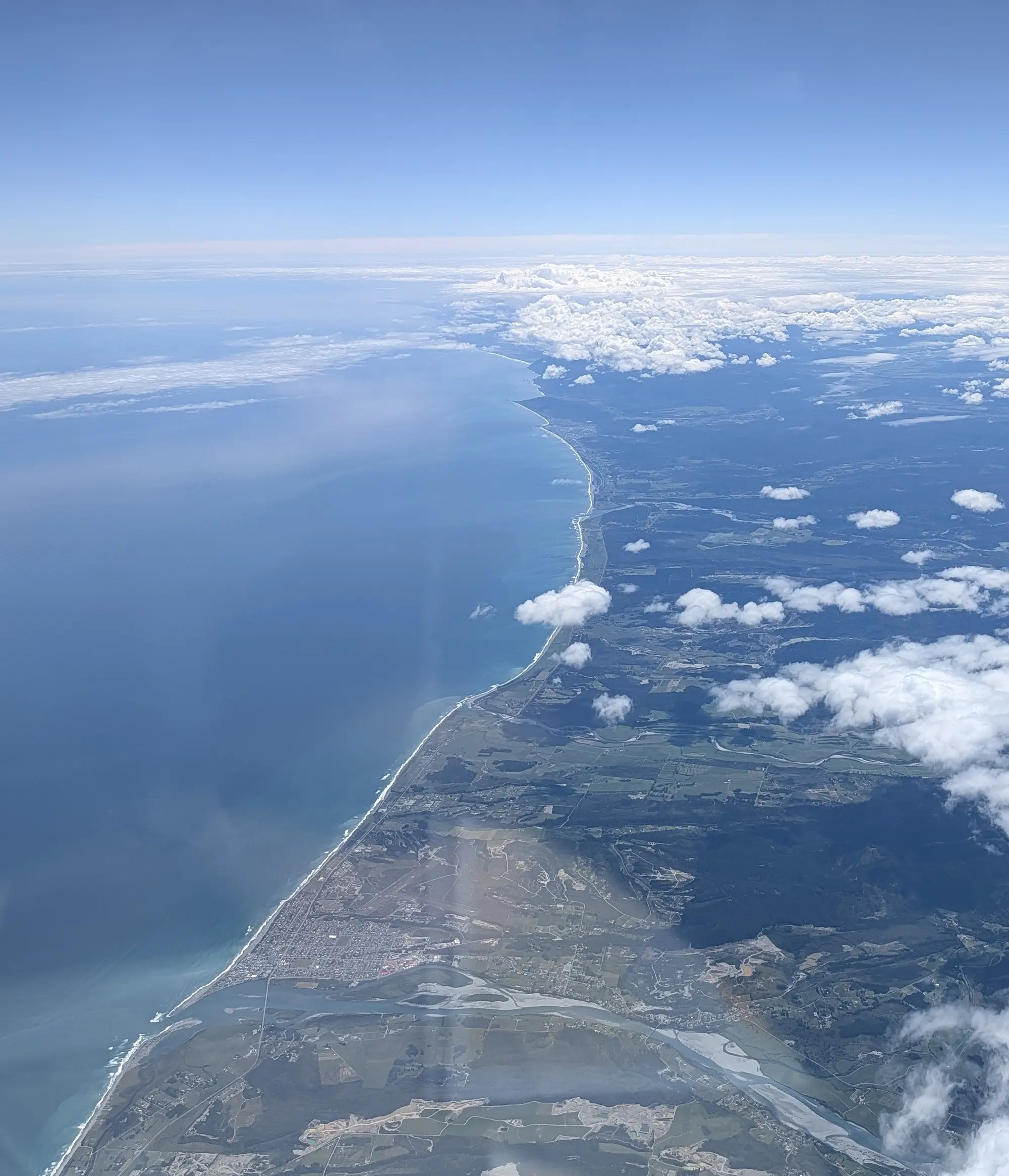
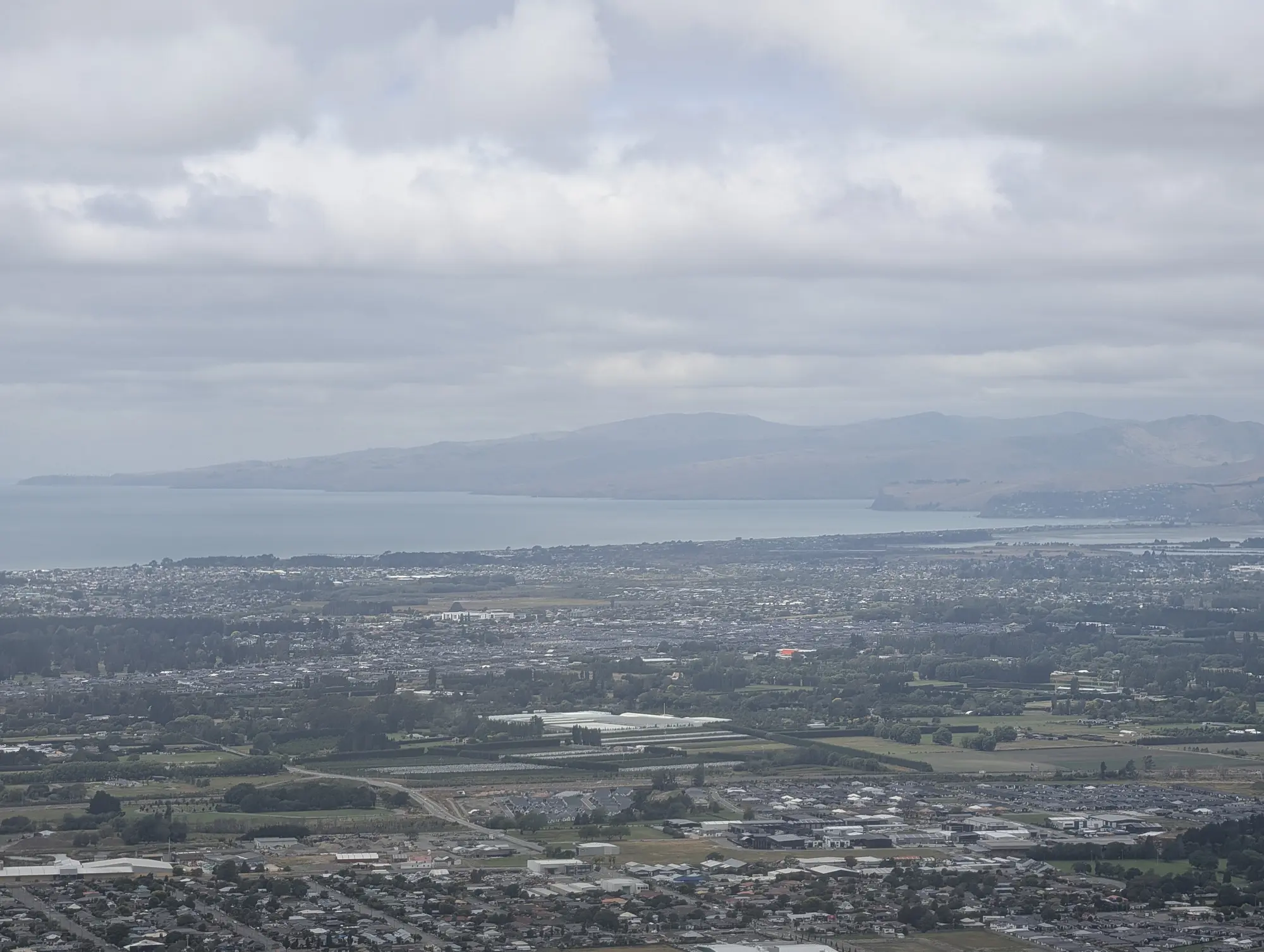
The steep green hills were dissected by braided rivers colored blue from glacial flour. The terrain continued to ascend to the snowcapped, cloud-kissed craggy peaks of the crest of the Southern Alps. Finally, as we dove into a bank of clouds, the mountains gave way to the expansive flatness of the Canterbury Plain. Christchurch, and its surrounding farms, sprawled just ahead. ‘Welcome to New Zealand,’ I thought.
Right about then, an announcement came over the plane’s in-flight video system. “Aoteroa welcomes you,” the nice kiwi in the video said, “but not your invasive plants and animals.” It turns out that somewhere around 80% of the native plants in NZ are endemic, so it feels reasonable they ask whether you have anything that may affect their unique biosphere. In fact, so reasonable that they demand you declare any potential pests or pest-bearing products, seeds, wood fragments, prepared food, and even outdoor equipment like tents and hiking gear.
They tell you this on the plane with an in-flight video, in which they ask nicely for you to do the right thing, or if you don’t, they will instantly fine you $400nz before finding the next thing to do to you. To streamline the process, they provide a form, which details things like whether you have any plant material (including herbs), or animal products, or even processed food.
Nodding to myself, I decided to adequately share that I have 2.5oz of coconut oil in my bag.
The plane touched down in Christchurch to a windy, grey day. We all deplane and walk to customs by about seven different iterations of the biosecurity message on posters, highlighting their instant $400 fine for violators who do not declare.
Seeing the sign on the walk to customs reminded me that I was carrying chili flakes - herbs and seeds which MUST be declared. Of course, I had neglected to include them on my form1.
A small pit of dread began to fill my stomach.
What would they do? Confiscate the items? Pull me aside and ask me where, exactly, they had come from? Would I be kicked out of the country I haven’t even gotten to? Would someone tell me - finally - that this idea, to go all the way around the world and ride north was a bad idea, and I was not prepared enough to pull it off, and that in fact I should find another way to get out my angst, something like knitting.
Getting close to spiraling off into unrecoverable territory, and with no one else to provide any dampening, the executive functioning self grabbed the reins, “Woahhh, there,” it said, “likely the worst that will happen is they get confiscated, and you can continue. Things are going to be fine2.”
I que-ed and eventually arrived at the front of the line, and, clearing my dry throat, told the customs agent, as clearly as I could, that I had coconut oil and chili flakes.
“Is that all you got?” Replied the customs agent “Yeah, that’s all.” “Ok,” he said, “Says here you also want to declare soils?” “Soils?” I responded, confused. “I’m not carrying soils.” “Ok…” The officer looked back at the screen. “And what about animal products? Do you have any of those with you?” “Uhh, no,” I said, growing flustered. “It’s just the coconut oil and the chili flakes?” “Well, why did you put the other things down if you don’t have them?” He asked. I gently squirmed for what felt like a looong moment before the agent laughed (at me, I am sure) and shook his head. “You must’ve selected no all the way down,” he said. The implied ‘you dummy’ did not need to be so clearly stated. “Alright, well, just go on ahead then,” he replied, waving me on.
And so on I went. In the country of New Zealand.
This was an off-putting moment for me. I had, in fact, been thinking a lot about this form on the plane. The flight attendant handed me a paper copy, and after filling it out, I decided to switch to the online version when I made a mistake. I thought through how exactly I would ensure that no matter what, they knew what I was carrying. I am sure in filling out the form, I must have missed something - I made too many mistakes for carelessness to be ruled out as a cause - but I did try my best to ensure transparency. But, apparently, all in vain. It felt like I was wasting the guy’s time, not that I was doing my best to ensure the requested transparency.
The reader may admonish me, saying, “Relax, Alex, it’s just a customs official. Plus, you did exactly what you set out to do - make sure they knew you were carrying some food.” Dear reader, you are absolutely correct3. And at the same time, the moment stuck with me. It highlighted for me that I did not know how to apply my effort to achieve the outcome I wanted, and more troubling, that I wasn’t even sure what outcome I even wanted in the first place.
Next order of business: Uber to my hotel.
I called the Uber, and waited. Licence plate number: ‘ADHIL’, white Prius. I waited a bit longer and then checked the driver’s location - apparently, he was right there. No ‘ADHIL’, but a white Prius sat at the curb about 15 feet away. I rechecked the app once again. Licence plate number: NL6G79 Driver Name: ADHIL I waved to the white Prius next to me.
My driver, Adhil, got out to get my bags. We loaded my enormous bike case into his car, along with the duffel I had. Then I walked to the passenger side (the car’s right side) and was quite surprised to find that 1) there was a steering wheel, and 2) Adhil was looking at me, head cocked. ‘Oh right, they drive on the other side of the road,’ I thought, closing the door. I laughed, a bit embarrassed, and went to the other side.
I think of myself as a detail-oriented person who can navigate the world around me to get what I want. In my home context, I am used to about a 100% hit rate. The occasional mistakes are few and far between, and often beyond my control. In my home context - the place that I know - I am well fit to the environment, and so I am confident and in control. But, across the world, in NZ, I had been instantly sat right back down by that same confidence, by silly and preventable mistakes.
The day continued with the same vibe, to a lesser extent - small errors making it quite clear that I did not, in fact, have my shit together as much as I thought I did. Every flinch as my Uber driver made a left turn into the left lane reminded me of that. Every moment, I smiled and nodded as I translated the Kiwi into American. Every time I was surprised or caught off guard, it reminded me that, even if NZ felt similar to where I am from, the place was actually quite different.
Was I losing my edge? Was I just going to keep making mistakes the WHOLE time I was here? Sitting in the car, the worry began to naw at me.
What has become clearer since is that my context has changed, and with it, my fitness to it. I am no longer able to be as confident as I was in a comfortable place. Or I can be as confident, but I am more likely to either make a fool out of myself or do something wrong. The solution is likely to ask for more help sooner.
This is what growth is: finding yourself in an uncomfortable place where you must adapt to a new situation and its particular eccentricities and uniquenesses. I think this surprise is what we lose when we grow accustomed to a place, and what we gain when we travel somewhere new.
It’s probably worth it, even if it’s uncomfortable sometimes. Shaking things up is undoubtedly why I am here.
Happy trails! More to come. Alex.

Footnotes:
Though it is not like I was required to write down all the things I was bringing, I was just to flag all the major categories I had with me. ↩︎
Having the flakes confiscated would suck. I collected the chili flakes from wild-growing Christmas Light pepper plants (known better as Chili Pequin) and processed the shockingly hot peppers into flakes for use later. The spice density is unmatched. Their loss would have been unfortunate, and they could not be matched 1:1 in NZ. ↩︎
Also adding that I should have taken the hint - Alex, you’re jetlagged, regardless of how you feel about it. Go to sleep, and try better next time. ↩︎